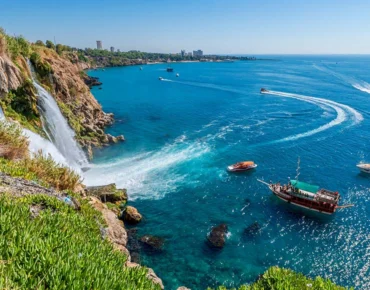
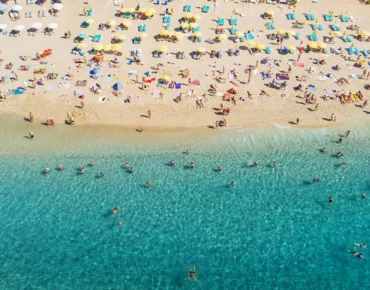
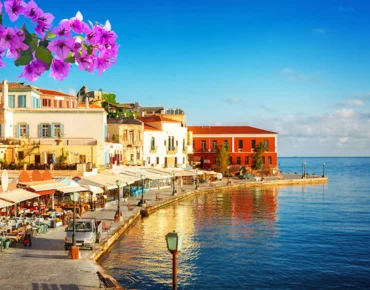
Coast-hopping — moving from one stretch of coastline to the next, stopping wherever the water looks too good to pass — is one of the most rewarding ways to travel. And few places in the world do it better than the Turkish Riviera, also known as the Turquoise Coast, where a single road connects ancient ruins, hidden coves, cliffside villages, and some of the most photographed beaches in the Mediterranean.
This guide walks you through the best coast-hopping route from Antalya to Fethiye, covering the key stops, practical logistics, and a few lesser-known highlights that most visitors miss. All that’s left is to browse through Corendon Airlines‘ best flight deals, book your flight, and look forward to your next adventure.
What Is the Turkish Riviera? Turquoise Coast and Lycian Coast Explained
You might have come across three different names for this stretch of coast: the Turkish Riviera, the Turquoise Coast, and the Lycian Coast. They all refer to overlapping sections of the same southwestern Turkish shoreline — but they carry slightly different connotations.
“Turkish Riviera” is the broadest term, generally covering the coastline from Antalya westward to Fethiye. “Turquoise Coast” is the most widely used name among English-speaking travellers, and with good reason — the colour of the water here really does justify it. The “Lycian Coast” refers more specifically to the stretch of coast that once formed the heartland of ancient Lycia, particularly the area around Kaş, Kalkan, and Fethiye, and tends to appeal to travellers with an interest in hiking or history.
For practical purposes, you can use all three interchangeably. The coast-hopping route from Antalya to Fethiye runs through all of them.
The Best Coast-Hopping Route: Antalya to Fethiye
The most natural way to explore the Turquoise Coast is to follow the D400 highway west from Antalya, dipping off the main road whenever something catches your eye — and something will, constantly. Below are the stops that make this Turkish Riviera itinerary worth the drive.
Antalya — Gateway to the Riviera
Most coast-hoppers fly into Antalya, and it’s worth spending a day or two here before hitting the road. The old quarter, Kaleiçi, is a warren of narrow streets, Roman-era walls, and Ottoman houses that have been converted into boutique hotels and rooftop bars. The harbour views alone are worth the stop.
From Antalya, the D400 heads southwest — and the real journey begins.
Kekova and Demre — Sunken Ruins and Turquoise Water
A detour down to Kekova is one of the best decisions you can make on this route. A boat trip across the bay reveals the Sunken City — the partially submerged ruins of an ancient Lycian settlement destroyed by an earthquake in the second century AD. You can see walls, staircases, and doorways beneath the water from the surface. It’s strange and beautiful and genuinely unlike anything else on the coast.
Nearby Demre is home to the Church of St. Nicholas — yes, that St. Nicholas — and the ancient Lycian city of Myra, where well-preserved rock tombs are carved directly into the cliff face.
Kaş — A Small Town with Big Charm
Kaş (anglicised from Kaş) is the kind of place that stops coast-hoppers in their tracks. It’s small, relaxed, and full of independent restaurants and dive shops rather than resort hotels. The town sits on a rocky peninsula with clear water on three sides and a Lycian sarcophagus sitting casually on a street corner, as if it’s always been there.
Kaş is also a base for scuba diving and day trips to Kekova by kayak or boat. If you’re planning to linger anywhere on this route, this is a strong candidate.
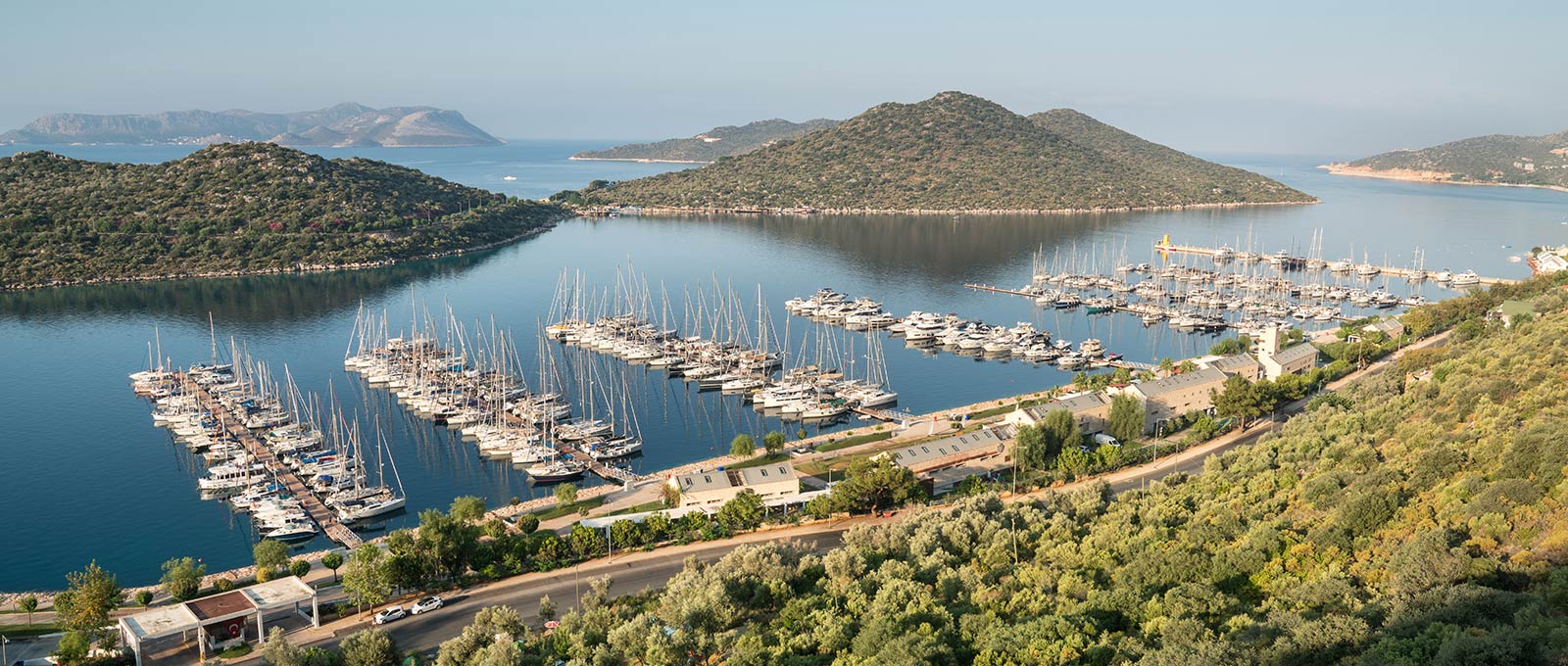
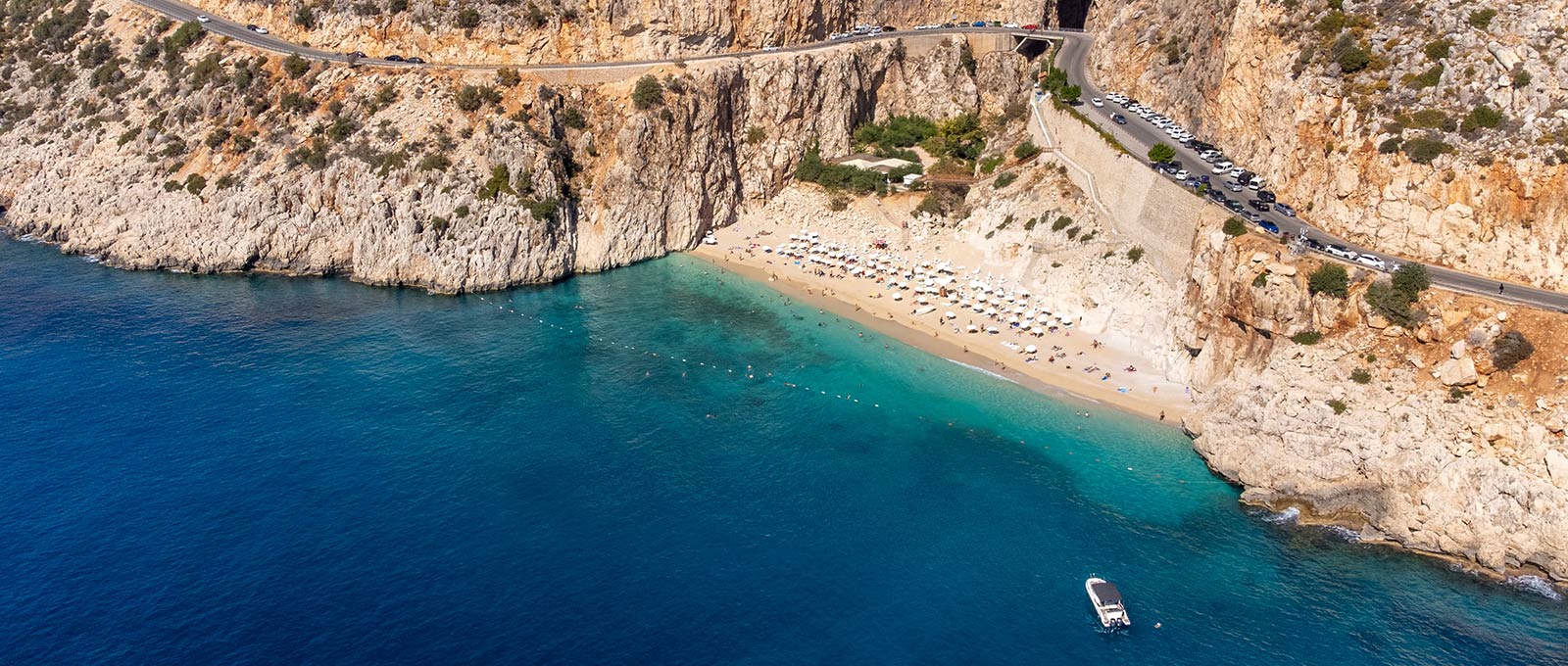
Kaputas Beach and Kalkan — One of Turkey’s Most Scenic Coastal Stretches
The road between Kaş and Kalkan is genuinely dramatic — all switchbacks, limestone cliffs, and sudden views of deep blue water far below. Kaputaş Beach (Kaputas Beach) sits at the bottom of a steep staircase cut into the rock, at the mouth of a narrow gorge. It’s small, striking, and very popular — arrive early if you want space.
Kalkan, a few kilometres further west, is all whitewashed houses and rooftop terraces spilling down towards the marina. It has a reputation as one of the more refined stops on the coast, with good restaurants and a quieter pace than Fethiye.
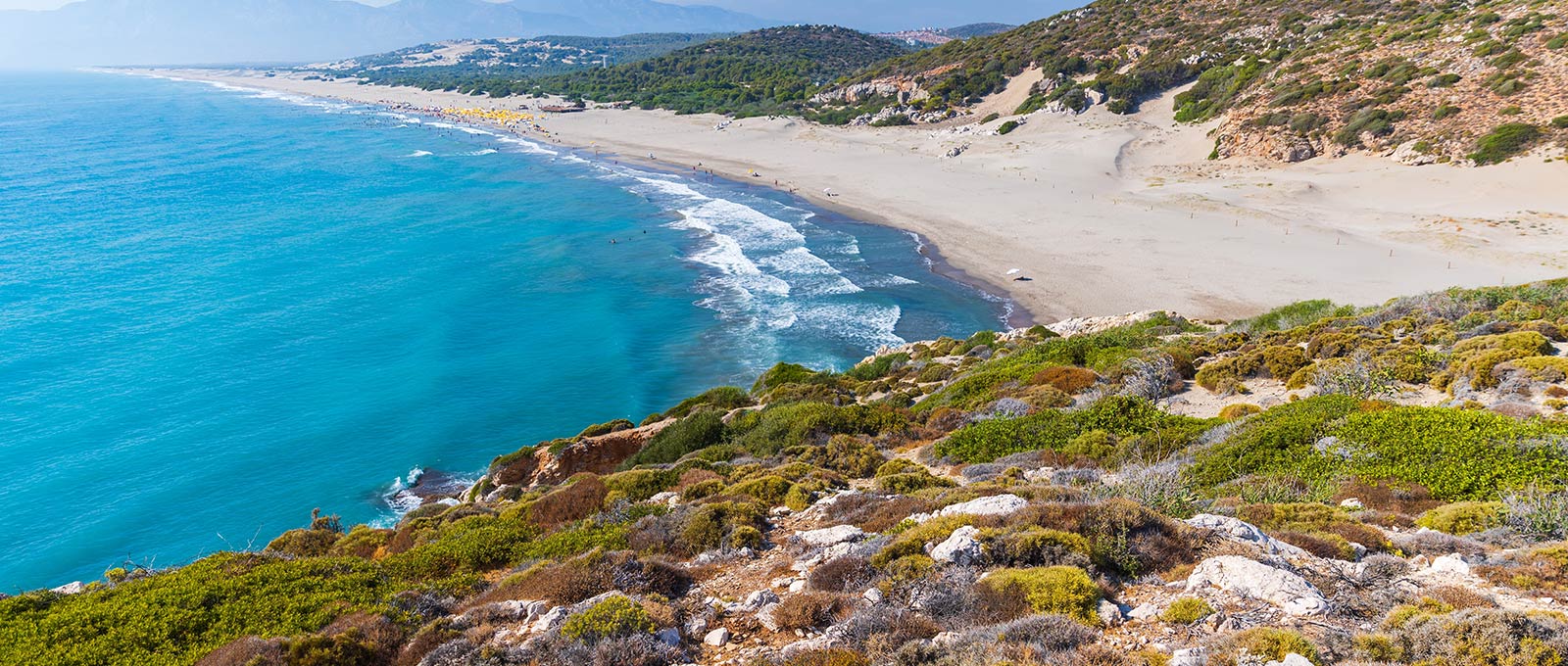
Patara — Endless Sand and an Ancient Harbor City
Patara is one of those places that makes you feel like you’ve found something most people missed. Its beach stretches for 18 kilometres — one of the longest in Turkey — backed by dunes and largely undeveloped, partly because the area is protected as a nesting site for loggerhead sea turtles.
Behind the beach, the ancient city of Patara includes a theatre, triumphal arch, and the ruins of a lighthouse thought to be among the oldest in the world. Patara was also the birthplace of St. Nicholas, making Demre and Patara an unexpectedly connected pair of stops.
Butterfly Valley — A Hidden Gem Near Fethiye
Butterfly Valley (Kelebekler Vadisi) is only accessible by boat or a steep, unmarked trail down the cliff — which keeps it quieter than most beaches in the area. The valley itself is home to dozens of butterfly species, and the beach is backed by a waterfall that runs in spring. Day trips depart regularly from Ölüdeniz and Fethiye.
Ölüdeniz and Fethiye — Blue Lagoon and the 12 Islands Boat Tour
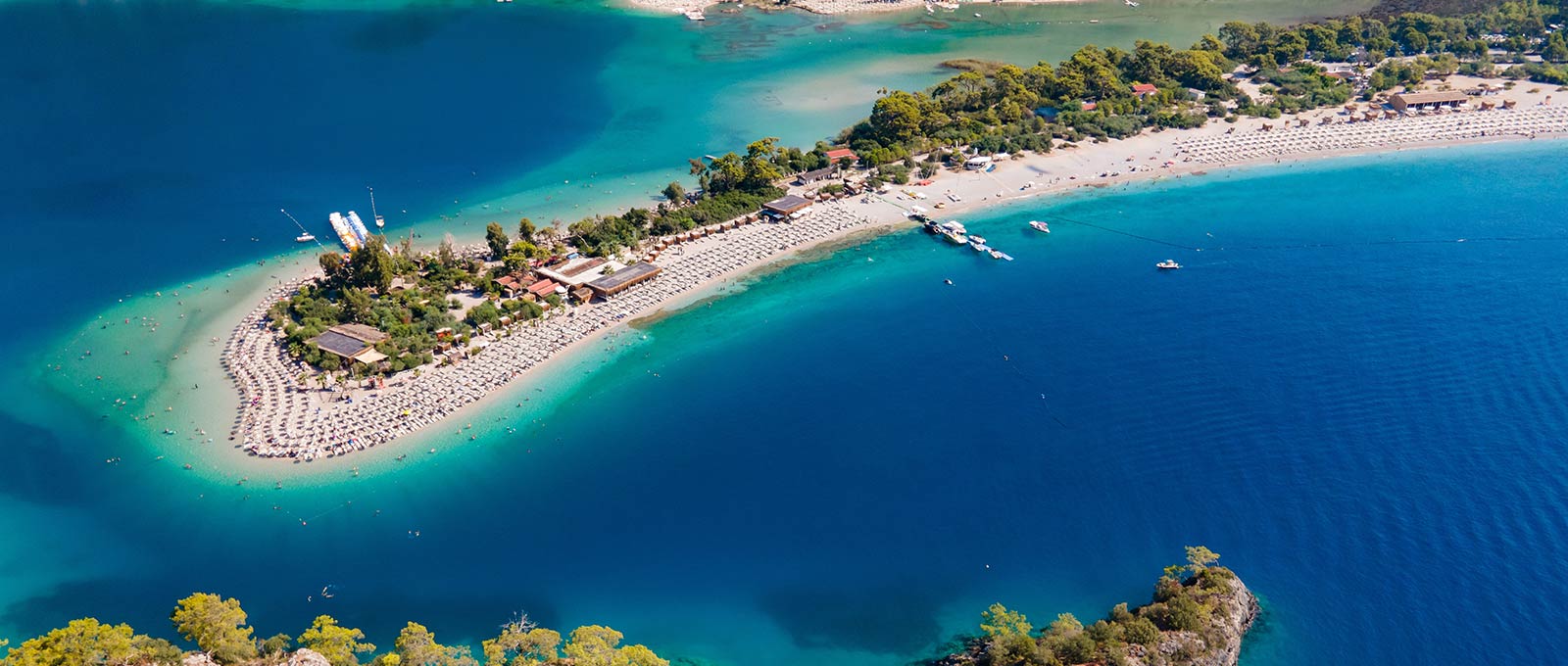
The route ends — or really, reaches its crescendo — at Ölüdeniz and Fethiye. Oludeniz beach and the Blue Lagoon at Ölüdeniz are among the most photographed spots in all of Turkey, and the reality lives up to the pictures: a sheltered bay of impossibly turquoise water flanked by forested mountains. Paragliding Ölüdeniz from Babadağ Mountain, which rises nearly 2,000 metres directly above the lagoon, is one of the most popular tandem paragliding experiences in Europe.
Fethiye itself is a lively harbour town with a good market, easy access to the 12 Islands boat tour, and a backdrop of Lycian rock tombs cut into the cliffs above the city. It’s a natural place to end the journey — or to start planning the next one.
Turkish Riviera Road Trip: Rental Cars, Logistics, and Planning Tips
A rental car is, without question, the most flexible way to do this route. Many of the best stops — Kaputaş, Butterfly Valley, Patara — are difficult or impossible to reach efficiently by public transport, and the freedom to pull over whenever the view demands it is most of the fun.
Rental car options are widely available at Antalya Airport, and rates are generally reasonable outside of peak summer weeks. A small car handles the coastal roads comfortably; an SUV gives you more confidence on unpaved detours. Book in advance for July and August.
Dolmuş (shared minibuses) connect most major towns along the coast and are cheap and reliable — a good backup option if you’d rather not drive, though they won’t get you to every stop on the list above.
Allow at least seven to ten days for the full Antalya to Fethiye route if you want to do more than drive through.
Blue Cruise: Exploring the Coast by Gulet
If driving feels like too much structure, a blue cruise — sailing the coast aboard a traditional wooden gulet — is the classic alternative. Blue cruise Turkey itineraries typically run for four to eight days between Fethiye, Kaş, Kekova, Marmaris, and Bodrum, with overnight anchoring in quiet coves that road-trippers can’t reach.
Gulet sailing is a well-established industry with options ranging from budget group cabins to fully private charter. It’s slower, more atmospheric, and swaps flexibility for the pleasure of waking up to a different stretch of water every morning.
The Lycian Way: Coast-Hopping on Foot
The Lycian Way is a long-distance walking trail that runs approximately 500 kilometres along the coast between Fethiye and Antalya. Sections of it pass through many of the stops on this route — the ruins at Patara, the cliffs above Kaş, the forests above Ölüdeniz — and can be walked independently or with a guided group.
You don’t need to do the whole trail to enjoy it. Many travellers walk a day section here and there between driving legs, and the combination works well. The trail is best walked in spring (April to May) or autumn (October to November) when temperatures are cooler.

Best Time to Visit the Turkish Riviera
May, June, and September are the sweet spots. The weather is warm, the sea is swimmable, and the crowds — while present — are manageable. July and August are peak season: very hot, very busy, and considerably more expensive, though the energy along the coast is undeniably lively.
April and October are quieter still, with mild temperatures and lower prices. Some smaller restaurants and boat operators close in winter, but the main towns stay open year-round.
Frequently Asked Questions
What is the best route for coast-hopping along the Turkish Riviera?
The most popular coast-hopping route runs from Antalya west to Fethiye along the D400 highway, stopping at Kekova, Demre, Kaş, Kaputas Beach, Kalkan, Patara, and Ölüdeniz along the way. The full route covers around 400 kilometres and is best done over seven to ten days to allow time at each stop.
How many days do you need to coast-hop from Antalya to Fethiye?
Seven days is a realistic minimum for the core stops; ten days gives you room to slow down, take boat trips, and explore side roads. If you only have four or five days, focus on the western half of the route — Kaş, Kalkan, Kaputas, and Ölüdeniz — which packs in the most variety in the shortest distance.
By the way: If you want to discover Antalya, before hopping right to the nex destination, don’t forget to check out our Antalya Travel Guide.
What are the most beautiful beaches between Antalya and Fethiye?
Ölüdeniz beach and the Blue Lagoon at Ölüdeniz top most lists, followed by Kaputas Beach (Kaputaş) near Kalkan and the long, wild sweep of Patara Beach. Butterfly Valley is worth adding for its remoteness and natural setting.
What is the difference between the Turkish Riviera, the Turquoise Coast, and the Lycian Coast?
All three names refer to overlapping stretches of the same southwestern Turkish coastline. “Turkish Riviera” covers the broadest area from Antalya to Fethiye. “Turquoise Coast” is the most commonly used English term for the same region. “Lycian Coast” refers more specifically to the historically Lycian stretch around Kaş, Kalkan, and Fethiye, and is particularly associated with ancient ruins and the Lycian Way hiking trail.
Do you need a rental car to explore the Turkish Riviera?
A rental car gives you the most flexibility and is the best option for reaching beaches like Kaputas and towns like Kalkan on your own schedule. That said, dolmuş minibuses connect the main towns, and a blue cruise covers the coast without any driving at all. Many travellers combine two of these options across a longer trip.
Is a blue cruise a good alternative to coast-hopping by car?
Yes — particularly if you want to reach secluded anchorages that aren’t accessible by road, or if you’d rather let someone else handle the logistics. Gulet sailing Turkey typically runs between Fethiye and Marmaris or Bodrum, so it covers a different section of the coast than the Antalya-to-Fethiye driving route. The two approaches complement each other rather than replace each other.
What is the Sunken City at Kekova?
The Sunken City at Kekova is a partially submerged ancient Lycian settlement near the village of Üçağız. An earthquake in the second century AD caused part of the coastline to drop into the sea, leaving walls, stairways, and building foundations visible just beneath the surface. Boat trips to the site are widely available from Kaş and from the village of Üçağız.
When is the best time to visit the Turkish Riviera?
May, June, and September offer the best balance of warm weather, calm seas, and manageable crowds. July and August are the hottest and busiest months. April and October are quieter and cooler, and still perfectly good for coastal travel.